
How many restrooms does a race actually need?
Course restrooms are different math than a construction site. OSHA 1926.51(c) sets ratios for workers on a jobsite, but a race is a moving crowd hitting a few pinch points hard: the start line, mile markers, and the finish festival. We usually stack extra standard portable toilets at the start corral since that's where 500 people show up 20 minutes before the gun and all need to go at once. Along the course, one unit every 1.5 to 2 miles per lane of runners keeps lines short without cluttering the route. Finish line and post-race festival areas need their own count, separate from the running course, because that's where people linger with family, drink water, and queue longest.
If your race pulls a regional field, expect racers from Leawood, 5.7 miles east, and Prairie Village, 10.5 miles northeast. Big Overland Park races often draw from Lee's Summit too, 21 miles east. Every runner counts toward your unit total regardless of where they parked. Use our placement guide to walk your course map before you lock numbers, and check our how many porta potties do I need breakdown for corral-specific math.
What does it cost to rent restrooms for a marathon?
A standard event-day unit runs $200 to $800, with most races landing near $400 for a full event rental according to our measured pricing across 21 race and festival bookings. Multi-day expos or weekend race weekends price differently than a single Saturday morning 5K, so tell us your full schedule up front.
| Unit type | Duration | Typical price |
|---|---|---|
| Standard unit | Event day | $400 |
| ADA unit | Day | $230 |
| Deluxe flushable | Week | $250 |
| Delivery fee | Day | $150 |
Race organizers in Overland Park often add a few deluxe flushable units near VIP or sponsor tents, and at least one ADA accessible unit per cluster is required under ADA Standards 213.2, which mandates 5 percent of clustered single-user units be accessible, never fewer than one. ADA Standards 405.2 caps ramp slope at 1:12 if your accessible unit sits on uneven turf, and ADA Standards 304.3.1 calls for a 60 inch turning circle in front of the door, so give that unit clear grass, not a slope. See our restroom trailer rental cost page if your finish festival wants trailer-style units instead of standalones, and our general porta potty rental cost page for baseline day and week numbers.
Timing tents, medical tents, and finish-line power setups often run off a generator or a tapped panel, and that means a temporary power pole staked near the timing table. Knowing how to brace a temporary power pole matters more on an open course field than on a jobsite: guy wires anchored at three points around the base hold it steady, or use a concrete-filled base plate if the ground won't take stakes, since wind gusts across open turf are the biggest reason a pole goes down. Pair that with GFCI protection per OSHA 1926.404(b)(1)(ii) if timing electronics or any wired equipment sits near a wash station. Check our temporary power pole page for setup details specific to open-field events.
Why do race restrooms need different placement than a jobsite?
A jobsite restroom sits in one spot for weeks. A race restroom exists for six hours and needs to survive a stampede of runners in the first ten minutes. Ground stability matters more than usual here: ADA Standards 302.1 requires stable, firm, slip-resistant surfaces, which means avoiding soft turf or gravel that shifts under a crowd. We stake units on turf and set them well clear of the timing mat and finish chute so nobody's blocking a sprint finish. Event restroom rental planning also means thinking about spectator zones separately from the runner corral, since family and friends cluster near the finish line for an hour after most runners have cleared out.
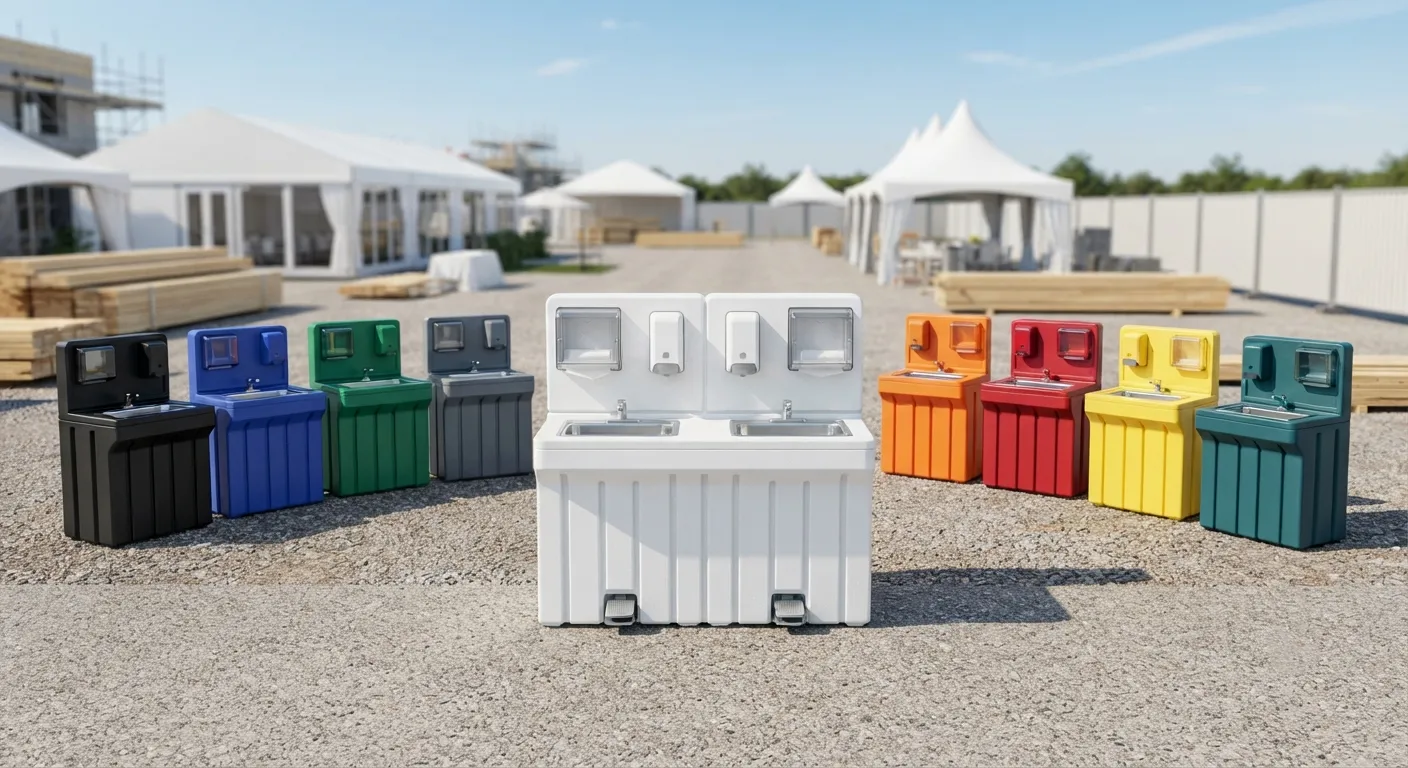
Handwashing matters too. A water station every couple miles means sticky hands and spilled electrolyte drinks, and 29 CFR 1910.141(d)(2) requires soap and towels or a hand-drying device at wash stations, not sanitizer alone. A handwashing station rental or two near the fluid stations covers that. For bigger races with a beer garden or food trucks at the finish, a portable sink rental near food vendors keeps hands clean between servings. Golf tournaments and county fair crowds face similar surges, so if your race weekend overlaps with another Overland Park event, book early.
How far in advance should I book race day restrooms?
Book 4 to 6 weeks out for anything over 300 runners. Course permits, city right-of-way approval, and unit counts all take time to lock down, and popular race weekends fill delivery slots fast across Overland Park.
Do I need a permit to place units along a public race route?
Placement in the public right of way needs confirming with the City of Overland Park directly; permit rules vary by route and street closure plan. Check our porta potty permit requirements page before finalizing your course map.
Can I get ADA units at every mile marker?
Most races place ADA units at the start, finish, and one or two mid-course points rather than every marker. ADA Standards 213.2 sets minimum ratios per cluster, not per mile, so talk placement through with us directly.
What happens if it rains on race day?
Units get staked and set on stable ground per ADA Standards 302.1 regardless of forecast. See our porta potty in winter page for cold and wet-weather notes that also apply to spring race season.
Do you service units mid-race for multi-hour events?
Yes, for marathons and longer festival-format races we can schedule a mid-event service pass. Ask about this when you request a quote so it's built into your route timeline from the start.
Next step
Get a delivery date
Tell us the address, the dates and the headcount. We size the order and confirm the route.